
What Does Remote Eye Exam Mean?
In simple terms, What Does Remote Eye Exam Mean also known as a virtual eye exam or tele-optometry exam is a modern method of receiving professional vision care through digital technology, where an optometrist evaluates your eye health either partially or fully through remote communication tools like high-definition video conferencing, AI-powered retinal scanning, and digital diagnostic equipment. Instead of always meeting your doctor in person, your exam can be conducted with the help of remote optometrists and on-site technicians, making eye care faster, more accessible, and more convenient than ever before.
As telehealth continues to transform the healthcare industry, these eye exams are becoming a preferred option for patients looking for flexible and efficient eye care solutions. But how exactly do they work? Are they accurate? And are they a full replacement for traditional eye exams? Let’s dive deep and understand everything clearly.
What does remote eye exam mean in Modern Eye Care?
A these eye exams is a combination of telemedicine technology and optometric care, allowing patients to undergo a full or partial eye examination without the physical presence of an optometrist in the same room. Instead, an on-site technician assists with the medical equipment, while a licensed optometrist evaluates your eye health and prescription from a remote location.
This form of vision testing is ideal for individuals who:
-
Have limited access to eye care providers
-
Prefer flexible appointment options
-
Live in rural or underserved areas
-
Want minimal in-office time
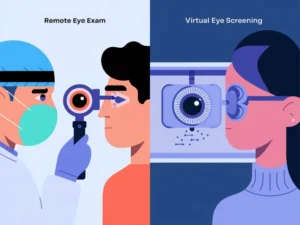
Remote Eye Exam vs Virtual Eye Screening – The Key Difference
A remote eye exam refers to a medically supervised telehealth consultation using real diagnostic equipment inside a clinic, assisted by a technician.
A virtual eye screening or an online vision test conducted through a phone or website is not the same and does not provide a medically approved prescription.
Important Note: This eye exams still involve clinical-grade diagnostic technology. It’s not an app-based test. A technician assists in person, while the doctor supervises live via video.
How Remote Eye Exams Work – Step-by-Step Process
Step 1: Initial Pre-Testing at the Clinic
-
Measurement of current prescription
-
Eye pressure check
-
Corneal curvature analysis
-
High-resolution retinal imaging
Step 2: Connection With a Remote Optometrist
You are connected to a licensed optometrist via secure HD video, where they review your diagnostic reports in real time.
Step 3: Vision Testing and Evaluation
The doctor performs vision clarity checks, assesses your prescription accuracy, and reviews your eye health using digital imaging data.
Step 4: Receive Your Digital Prescription Instantly
Once approved, your prescription is sent digitally, allowing you to order glasses or contact lenses immediately.
Remote Eye Exam vs Traditional Eye Exam – A Detailed Comparison
| Feature | Remote Eye Exam | Traditional Eye Exam |
|---|---|---|
| Doctor Interaction | Live via video | In-person consultation |
| Equipment | Digital, AI-supported tools | Digital and manual equipment |
| Time Taken | 20–30 minutes | 30–45 minutes |
| Accessibility | Highly flexible | Depends on clinic scheduling |
| Best For | Routine exams, follow-ups, prescriptions | Complex eye conditions |
| Insurance Coverage | Covered by most plans | Covered by most plans |
| On-Site Doctor Presence | Technician present, doctor remote | Doctor physically present |
Benefits of Eye Exams
Better Access for Rural and Senior Patients
Patients in remote areas or seniors who struggle with transportation gain easier access to licensed optometrists.
Shorter Appointment Times
With digital workflows and remote specialists, wait times are significantly reduced.
Convenience for Busy Individuals
Working professionals and parents can benefit from quicker sessions without compromising accuracy.
Early Detection with AI Imaging
High-resolution retinal imaging can detect early signs of eye diseases with precision.
Who Should Consider a Remote Eye Exam?
-
Seniors needing regular checkups
-
Patients needing glasses or contact lens prescription updates
-
Individuals with limited mobility or transportation options
-
Patients requiring follow-up monitoring rather than full physical exams
Are Remote Eye Exams Accurate and Safe?
AI and Digital Imaging Improve Accuracy
Digital retinal scans and AI-supported analysis help detect eye conditions earlier, offering high diagnostic confidence.
Limitations of Remote Eye Exams
While ideal for routine care, some conditions still require in-person diagnostic tools, including:
-
Complex glaucoma evaluations
-
Neurological vision disorders
-
Injuries and infections needing physical examination
Compliance and Safety Standards
Clinics offering remote exams follow telehealth compliance, ensuring HIPAA and FDA-approved medical practices.
What to Expect During Your First Remote Eye Exam
Before the Appointment
-
Bring your current eyewear if possible
-
Be prepared to answer eye health questions
-
Have your medical history details ready
During the Appointment
-
A technician conducts imaging and initial tests
-
You connect with an optometrist virtually
-
The doctor evaluates your results live
After the Exam
-
Your digital prescription is issued
-
You can order glasses or schedule follow-up care immediately
Common Myths About Remote Eye Exams – Debunked
Myth: Remote eye exams aren’t done by real doctors
Truth: Only licensed optometrists conduct remote tele-optometry consultations.
Myth: Remote exams can’t detect diseases
Truth: AI-powered retinal imaging detects early signs of major eye conditions with high accuracy.
Myth: It’s just an online test
Truth: Remote exams are conducted using real clinic-based diagnostic devices.
Myth: Insurance doesn’t cover it
Truth: Most insurance providers cover remote exams under standard vision plans.
Most Searched FAQs About Remote Eye Exams
1. What does remote eye exam mean in telehealth?
It refers to a professional eye examination where the doctor evaluates your vision digitally using tele-optometry technology while you are present at a clinic with diagnostic equipment.
2. Can I get glasses from a remote eye exam?
Yes, a valid prescription is issued immediately after the exam.
3. Are remote eye exams accurate?
Yes, when done using proper retinal imaging and technician assistance, accuracy matches in-person exams.
4. Are remote eye exams covered by insurance?
Most vision plans cover remote eye exams. Some imaging upgrades may be additional.
5. Can remote exams detect diseases?
Yes, they can detect early signs of glaucoma, macular degeneration, and diabetic eye conditions.
6. How long does a eye exam take?
Around 20–30 minutes.
7. Do I still need to visit a clinic?
Yes, but only to use the diagnostic machines. The doctor consults remotely.
Ending Notes
A remote eye exam is a modern, efficient, and highly accurate way to receive professional eye care without the traditional wait times and scheduling challenges of in-person visits. With advanced retinal imaging, AI-enhanced diagnostics, and licensed optometrists supervising every step, this eye exams bring expert-level care with greater convenience and accessibility.
If you need routine vision updates, faster appointments, or a flexible eye care solution, an eye exam is a smart and modern alternative to traditional visits.
📍 Visit Us: 3479 Wedgewood Ln, The Villages, FL 32162
📞 Call Now: (352) 775-2833
🗓 Book Online in Seconds: https://villagesoptical.com/book-eye-exam-village-optical/