
Your child’s most essential learning tool is their vision. Yet, for many parents, the difference between a simple school screening and a comprehensive pediatric eye exam remains unclear. An astonishing $\mathbf{80\%}$ of all a child learns in their first 12 years comes through their eyes. Missing a subtle vision problem can lead to learning difficulties, poor sports performance, and even permanent vision loss.
At Villages Opticals, we don’t just check to see if your child can read the $20/20$ line; we perform a meticulous, age-appropriate pediatric eye exam that assesses the entire visual system. We are the leading specialists in comprehensive children’s eye care in Lady Lake, Wildwood, and Summerfield, committed to optimizing your child’s visual potential from infancy through their teenage years.
This authoritative guide provides an unparalleled, detailed breakdown of our pediatric eye exam services, its critical importance, the specialized techniques we use, and a full transparency on cost and insurance ensuring you have the confidence to invest in your child’s success.
Part I: Why the Pediatric Eye Exam is Non-Negotiable (The $80\%$ Rule)
A child’s eyes are not just miniature versions of adult eyes; they are a rapidly developing system. The critical period for visual development is from birth up to age seven or eight. If a vision problem is not corrected during this time, the brain may permanently ignore the visual input from the affected eye, leading to irreversible vision loss. This is the central reason a professional pediatric eye exam is vital.
A. The Stakes: Differentiating Vision Screening from a Medical Exam
Parents often rely on vision screenings offered at school or by a pediatrician. While these are useful preliminary checks, they are fundamentally inadequate for ensuring lifelong eye health.
| Feature | School/Pediatrician Vision Screening | Comprehensive Pediatric Eye Exam (Villages Opticals) |
| Goal | To check distance visual acuity only. | To assess visual acuity, eye health, focusing, tracking, and binocularity. |
| Scope | Limited to reading letters/symbols at a distance. | $360^{\circ}$ evaluation including the retina, optic nerve, and corneal health. We look for disease, not just clarity. |
| Detection Rate | Fails to detect $\mathbf{50\%}$ of vision problems, especially farsightedness and subtle alignment issues. | High-fidelity detection of the three major threats: Amblyopia, Strabismus, and significant Refractive Errors. |
| Provider | Non-specialist or volunteer. | Board-Certified Optometrist with specialized training in pediatric techniques and developmental vision. |
A successful school screening only means your child can see far away on that specific day. A pediatric eye exam means a specialist has confirmed that all the necessary visual skills for reading, learning, and future health are developing correctly.
B. Key Developmental Stages and Recommended Pediatric Eye Exam Schedule
Visual development proceeds in critical stages. We adhere to the internationally recognized guidelines for the frequency of a pediatric eye exam:
- Infancy (6-12 Months): The first pediatric eye exam. This is a functional assessment to check for proper alignment, light response, and rule out rare but serious conditions like congenital cataracts or retinoblastoma. We participate in programs like InfantSEE, often offering this initial pediatric eye exam at no charge to remove barriers to critical early detection. Early detection of serious issues like a blocked tear duct or a congenital cataract can save a child’s sight.
- Preschool (Age 3): The second pediatric eye exam is performed before a child enters school. This is the optimal window to catch Amblyopia (lazy eye) and large amounts of farsightedness that can interfere with near tasks. Children at this age are ready for simple picture charts, and we can begin formal testing of depth perception.
- School Age (Age 5-6/Kindergarten): The pre-academic pediatric eye exam. Ensures the child has all necessary visual skills for classroom demands, including sustained near focusing for reading and clear distance vision for the whiteboard. We confirm that their visual system can handle the sudden increase in near work.
- Subsequent Exams: Annually or every two years, depending on the child’s prescription and risk factors. Children with existing vision correction or those undergoing Myopia Management require annual or more frequent follow-up pediatric eye exams.
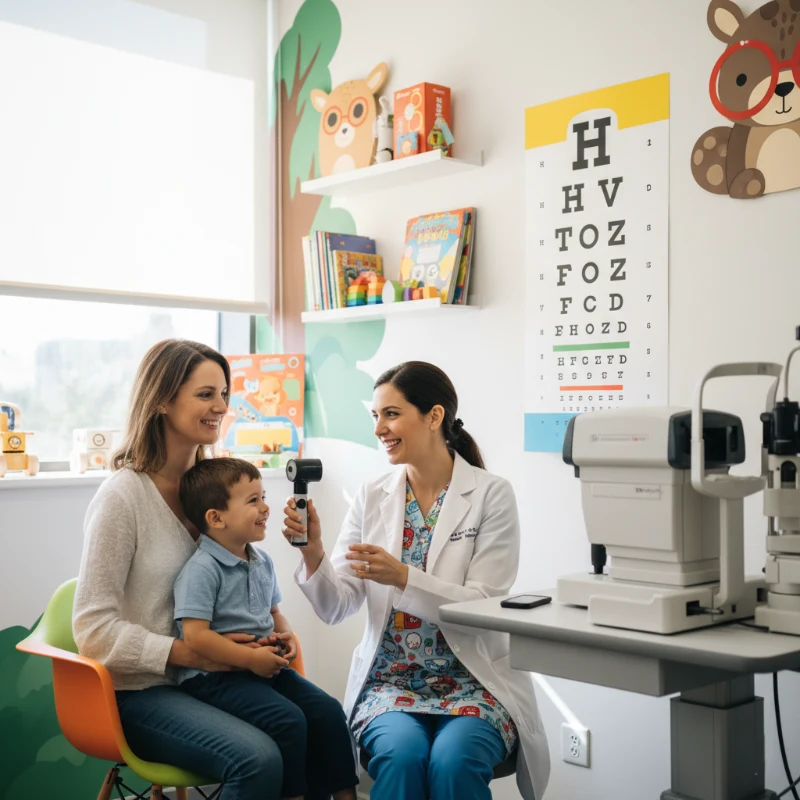
Part II: The Villages Opticals Pediatric Eye Exam Protocol: Precision for Every Age
Performing a pediatric eye exam requires specialized skills and patience because children cannot provide subjective feedback. Our optometrists use objective techniques that are an “art and a science” to gain accurate data independent of the child’s cooperation. We have perfected a suite of testing methods tailored to the attention span and developmental level of every child.
A. Specialized Techniques for Pre-Verbal Children (Ages 0-3)
The pediatric eye exam for infants and toddlers is a detective process focusing on reflexes and behavioral observation. The ability to perform an accurate exam on a non-verbal child is the hallmark of a true pediatric specialist.
| Test Name | Purpose in Pediatric Eye Exam | Detailed Technique and Significance |
| Red Reflex Test | Screens for media opacities (e.g., cataracts) and serious retinal issues. | Shining an ophthalmoscope light into the pupil and observing the reflection. A dull, white, or asymmetrical reflex requires urgent referral. The symmetry of the reflex helps detect unequal prescription between eyes (Anisometropia), a major cause of Amblyopia. |
| Fixate and Follow | Evaluates eye movement and tracking ability, checking for gross Strabismus and tracking skill. | Using a small, silent, highly engaging toy or light to see if the child’s eyes can consistently fixate on and follow a target through all nine fields of gaze. Poor tracking can be an early indicator of developmental delays. |
| Retinoscopy (The Gold Standard) | Objectively measures the child’s prescription. This is non-negotiable for a thorough pediatric eye exam. | The doctor shines a light into the eye and measures the reflection (retinoscopic reflex) as lenses are changed, determining the refractive error (Myopia, Hyperopia, Astigmatism) without the child saying a word. It’s the most reliable way to find hidden farsightedness. |
| Preferential Looking | Estimates visual acuity in infants and children with developmental delays. | Using cards with high-contrast patterns (gratings) on one side; infants will naturally look toward the more interesting, patterned side. By decreasing the size of the stripes, we can accurately estimate the baby’s vision. |
| Corneal Light Reflex | Quick check for eye alignment (Strabismus). | Observing where a light reflects on the cornea of each eye. If the reflections are not centered and symmetrical, it indicates misalignment. |
B. Testing for Preschool & School-Aged Children (Ages 3+)
Once a child is verbal or cooperative, the pediatric eye exam transitions to more interactive, yet still objective, techniques. This stage is crucial for diagnosing subtle, yet highly impactful, learning-related vision issues.
- Modified Visual Acuity Charts: We move beyond the traditional Snellen chart. We use age-appropriate tools like HOTV, LEA Symbols, or the Tumbling E chart, where the child only needs to match shapes or point in a direction. We test each eye individually to detect subtle vision differences that would lead to Amblyopia.
- Near-Point Testing and Accommodation: This assesses the ability to focus up close and maintain that focus over time. We check the Near Point of Convergence (how close the eyes can turn inward) and the amplitude of accommodation (the strength of the focusing muscle). Issues here are common culprits for headaches after reading or difficulty copying from the board.
- Color Vision Testing (Ishihara Plates): A basic test included in the comprehensive pediatric eye exam to screen for inherited color vision deficiency, which is important for future career choices and daily life.
- Depth Perception (Stereopsis) Testing: Using specialized polarized glasses and visual targets, we measure the child’s ability to use both eyes together to perceive depth. Poor stereopsis can affect performance in sports, driving, and tasks requiring fine motor skills.
- The Power of Cycloplegic Refraction: Essential for Accuracy: This is often a necessary component of a precision pediatric eye exam. Special medicated eye drops are used to temporarily relax the child’s focusing muscle (accommodation). Children’s focusing muscles are extremely strong, and they can unknowingly “focus past” or mask a significant amount of farsightedness (Hyperopia). The cycloplegic drops reveal the true total prescription, preventing misdiagnosis and ensuring optimal correction to treat or prevent Amblyopia. Without this step, many subtle, but learning-disrupting, vision problems are missed.
Part III: The Three Major Threats: What the Pediatric Eye Exam Prevents
The cost of a pediatric eye exam is negligible compared to the lifetime cost of managing a condition that could have been corrected early. Our primary focus is preventing the “Three A’s” the most common and most damaging childhood vision problems.
A. Amblyopia (Lazy Eye): The Silent Threat
Amblyopia is the leading cause of monocular vision loss in children. It’s not a structural problem with the eye but a failure of the brain to develop a connection with one eye due to disuse.
- Mechanism: It is often caused by an uncorrected large refractive error (Anisometropia) or eye misalignment (Strabismus). The brain receives a blurry or confusing image from the affected eye and simply ignores it, shutting down the visual pathway.
- Diagnosis in the Pediatric Eye Exam: Amblyopia is detected when there is a significant difference in the vision (visual acuity) between the two eyes. We use sophisticated, modern screening devices that measure Binocular Retinal Birefringence (like the blinq® system) to objectively screen for faulty fixation, a direct sign of Amblyopia, even in non-verbal children.
- Treatment Window and Urgency: The key to successful treatment is intervention before age $\mathbf{7-9}$, before the visual system is fully wired. The pediatric eye exam is the only way to find this condition early enough to initiate treatment with patching, atropine drops, or corrective eyewear, dramatically improving the prognosis.
B. Strabismus (Crossed/Turned Eye): A Coordinated Effort
Strabismus is an ocular misalignment where the eyes do not point in the same direction. It is a binocular vision problem that affects depth perception.
- Mechanism: The eyes may turn inward (Esotropia), outward (Exotropia), up (Hypertropia), or down (Hypotropia). This can be intermittent or constant, often becoming more noticeable when the child is tired or sick.
- Diagnosis in the Pediatric Eye Exam: We use the Cover/Uncover Test and the Corneal Light Reflex Test. These non-invasive, objective tests observe how the eyes move when one eye is momentarily covered, revealing even subtle misalignments (Microstrabismus) that can cause eye strain, double vision, and, crucially, Amblyopia.
C. Uncorrected Refractive Error: The Learning Barrier
This includes Myopia, Hyperopia, and Astigmatism. While not a disease, uncorrected errors are the most common cause of academic struggle and visual fatigue in children.
- Myopia (Nearsightedness): Blurry distance vision. Can lead to a child struggling to see the board, often resulting in them being wrongly labeled as inattentive or poorly behaved.
- Hyperopia (Farsightedness): Requires constant effort to focus, leading to eye fatigue, headaches, and avoidance of reading. Hidden Hyperopia is the most frequent cause of Amblyopia and is only reliably diagnosed with a cycloplegic pediatric eye exam.
- Astigmatism: Distorted vision at all distances due to an irregularly shaped cornea. The pediatric eye exam uses specialized retinoscopy and Keratometry to accurately measure the complex, oval shape of the cornea.
Part IV: Financial Transparency: Cost of a Pediatric Eye Exam at Villages Opticals
We believe that no child’s future should be compromised by confusing billing. The cost of a pediatric eye exam is highly dependent on insurance, which is often more complex for children than adults. We strive for full transparency for all our patients in Lady Lake, Wildwood, and Summerfield.
A. Insurance Coverage: Vision vs. Medical for Children
Unlike adults, the line between Vision Insurance and Medical Insurance is often blurred for children, especially under the Affordable Care Act (ACA).
- ACA Mandate: The ACA mandates that pediatric vision care is an Essential Health Benefit (EHB), meaning all qualified health plans must cover one comprehensive pediatric eye exam per year.
- Billing Scenario 1 (Routine Exam): If the visit is purely for a check-up, it is billed through Vision Insurance (VSP, EyeMed, Spectera, Davis Vision, etc.). Your out-of-pocket cost will likely be a small Copay (typically $\text{\$10 – \$40}$) plus the separate Refraction Eye Exam fee (if applicable).
- Billing Scenario 2 (Medical Management): If your child has a pre-existing medical condition (e.g., Strabismus, diabetic eye checks, eye injury) or develops one during the exam, the visit is billed through Medical Insurance (Aetna, Blue Cross, Cigna, United Healthcare, etc.). This is then subject to your family’s Deductible and Copay. We always attempt to use the most advantageous coverage for your family.
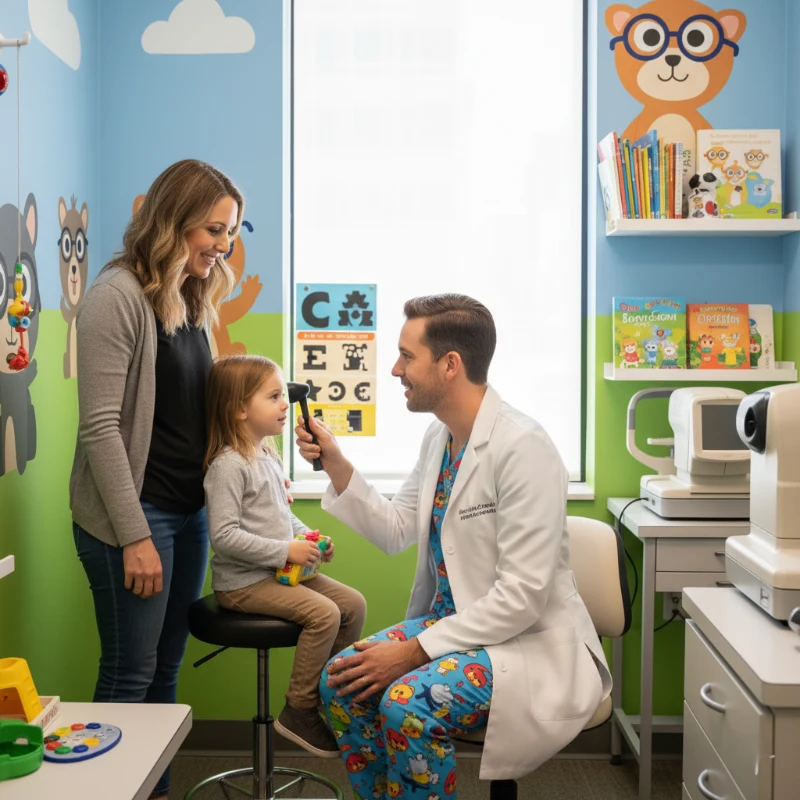
B. Estimated Cost Breakdown (Without Insurance for Lady Lake, Wildwood, and Summerfield Residents)
For families in the local area who do not have vision coverage, we offer transparent pricing that reflects the time and specialized technology required for a precise pediatric eye exam.
| Service Component | Villages Opticals Fee (No Insurance) | Rationale for Cost |
| Comprehensive Pediatric Eye Exam (Base Price) | $\text{[Competitive Rate: e.g., \$160 – \$220]}$ | Reflects the specialized equipment (retinoscope, corneal topographer) and the extended time required for non-verbal or minimally cooperative patients. |
| Refraction Eye Exam (Inclusion of Cycloplegia) | $\text{[Standard Fee: e.g., \$50 – \$75]}$ | Covers the skill required for objective refraction and the cost of the necessary cycloplegic drops to ensure the most accurate prescription. |
| Advanced Diagnostic Fee (e.g., OCT/Retinal Imaging) | $\text{[Standard Fee: e.g., \$40 – \$60]}$ | Optional but highly recommended for children with high prescriptions (Myopia) or family history of eye disease, providing a superior health baseline and retinal check. |
| Total Estimated Investment | $\text{[Total Range: e.g., \$250 – \$355]}$ | A high-value investment in future academic performance and lifelong sight. |
Important Note on Follow-Up: The fee for the initial pediatric eye exam often includes a brief follow-up visit within a set period (e.g., 30 days) to confirm the final prescription or check on the initial response to treatment (e.g., patching compliance). This is a commitment to precision.
Part V: The Behavioral Clues: When to Schedule a Pediatric Eye Exam Immediately
Parents are often the first line of defense. The following list details the warning signs that necessitate an immediate, non-routine pediatric eye exam at Villages Opticals—do not wait for the annual check-up if these symptoms appear.
Top 10 Warning Signs Your Child Needs a Pediatric Eye Exam:
- Consistent Squinting or Head Tilting: A coping mechanism to try and clear blurry vision or fuse double vision caused by Strabismus or significant Astigmatism.
- Frequent Eye Rubbing or Excessive Blinking: Suggests eye fatigue or strain, often from uncorrected Hyperopia (farsightedness) or dry eyes from extended screen time.
- Sitting Too Close to the TV/Holding Books Close: A classic sign of Myopia (nearsightedness) or a focusing difficulty. They are moving the object closer to make it clearer.
- Covering One Eye or Shutting One Eye: Indicates a significant difference in vision between the two eyes (Anisometropia), a major risk factor for Amblyopia, or an attempt to eliminate double vision.
- One Eye Turns In or Out (Even Intermittently): Definite sign of Strabismus, requiring immediate evaluation to prevent Amblyopia.
- Complaints of Headaches or Eye Strain (Especially Late in the Day or After School): Suggests excessive focusing effort for near tasks due to uncorrected Hyperopia or binocular vision issues.
- Poor Hand-Eye Coordination: Difficulty catching a ball, clumsiness, or poor depth perception can be directly linked to uncorrected vision or a lack of Stereopsis.
- Losing Place While Reading or Skipping Lines: Indicates a problem with eye teaming and tracking (Binocular Vision Dysfunction), which the pediatric eye exam thoroughly assesses.
- Low Academic Performance: An undiagnosed vision problem is often the root cause of difficulty reading, short attention span, or refusal to do homework. Vision problems are frequently misdiagnosed as learning disabilities or ADHD.
- A White or Grayish-White Pupil (Leukocoria): A rare but severe warning sign that requires an emergency pediatric eye exam to rule out conditions like retinoblastoma (a life-threatening tumor) or severe cataracts.
Part VI: Myopia Management: A Specialized Focus within the Pediatric Eye Exam
A rapidly increasing area of specialized care at Villages Opticals is Myopia Management. High Myopia (severe nearsightedness) is not just a prescription issue; it is a major eye health risk linked to future pathologies like retinal detachment, cataracts, and glaucoma. Slowing Myopia progression is a core pillar of our advanced pediatric eye exam services.
A. Why Standard Glasses Are Not Enough and the Risk of Axial Length
Standard spectacle lenses correct vision but do nothing to slow the physical elongation of the eye (axial length), which is the root cause of Myopia progression. Every millimeter the eye grows beyond normal increases the lifetime risk of blinding conditions. Our comprehensive pediatric eye exam for children with Myopia includes baseline axial length measurements using advanced biometry technology, allowing us to track the true progression of the condition and intervene effectively.
B. Myopia Control Options Offered at Villages Opticals
A standard pediatric eye exam identifies the problem; a Myopia Management plan provides the long-term solution. Our optometrists are certified in all three proven modalities:
- Low-Dose Atropine Therapy: Medicated drops administered nightly to slow the growth of the eye. This is a simple, non-invasive method that has proven highly effective and is often used in combination with other treatments.
- Orthokeratology (Ortho-K): Specialty rigid contact lenses worn only at night to gently reshape the cornea. The child sees clearly all day without glasses or contacts. This not only corrects the vision but also signals the eye to slow its growth.
- Multifocal Contact Lenses: Soft contact lenses designed to correct central vision while creating a defocused signal in the periphery. This peripheral defocus signal is proven to slow eye growth and is a highly comfortable option for school-aged children.
The cost of a Myopia Management program is separate from the routine pediatric eye exam fee and involves more frequent follow-ups and specialized lens costs. However, it is the single greatest investment you can make in preserving your child’s long-term eye health in Lady Lake, Wildwood, and Summerfield.
Part VII: Going Beyond 20/20: Developmental and Visual Processing Assessment
A true comprehensive pediatric eye exam goes beyond simply correcting refractive errors. It investigates the subtle, often missed, disorders of visual processing that can severely impact learning.
A. Convergence Insufficiency (CI)
This is a condition where the eyes have difficulty turning inward (converging) to maintain focus on a near object, such as a book or tablet.
- Symptoms: Double vision, headaches, eye strain, difficulty concentrating, and skipping lines while reading. Children with CI are often diagnosed with attention problems due to their inability to sustain focus on near tasks.
- Diagnosis: Measured during the near-point testing portion of the pediatric eye exam. We assess both the near point of convergence and the ability of the eyes to break and recover from convergence.
- Treatment: Customized Vision Therapy exercises prescribed by our doctor to train the eyes to work together effectively.
B. Oculomotor Dysfunction (Tracking Problems)
This involves poor control of the eye muscles, resulting in inaccurate and choppy eye movements required for reading.
- Symptoms: Losing place when reading, using a finger to track, excessive re-reading, and reduced reading comprehension.
- Diagnosis: We use specialized testing techniques to observe and measure saccades (quick, jumpy movements between words) and pursuits (smooth, following movements).
- Impact: A significant, yet commonly overlooked, barrier to reading fluency and reading comprehension that a general eye exam will miss but a thorough pediatric eye exam will uncover.
Part VIII: The Villages Opticals Commitment to the Lady Lake, Wildwood, and Summerfield Communities
Our dedication to the pediatric eye exam is a commitment to the entire local community. We understand the specific needs of families in Lady Lake, Wildwood, and Summerfield.
- Kid-Friendly Environment: Our office is designed to reduce anxiety. Our instruments are adapted to be non-threatening, and our staff excels at keeping young patients relaxed and engaged throughout the entire pediatric eye exam. We use fun, motivating targets and keep the pace quick and engaging.
- Coordination with Educators: We are available to coordinate directly with your child’s teachers and school nurses to ensure their visual needs are met in the classroom environment. A simple note from our optometrist detailing the specific visual condition can transform a child’s learning experience.
- Durable Eyewear Solutions: Should your pediatric eye exam result in a prescription, we offer a dedicated line of children’s frames that are durable, flexible, and covered by robust warranties—acknowledging that kids are active and require resilient eyewear. We educate both the child and the parent on the importance of wearing the glasses as prescribed to avoid relapse or worsening of conditions like Amblyopia.
- Convenient Locations: Families in Lady Lake, Wildwood, and Summerfield can easily access our expert care, making the essential pediatric eye exam a stress-free priority.
End Notes: Invest in a Pediatric Eye Exam, Invest in Their Future
The most valuable prescription your child will ever receive is the one that starts with an accurate, specialized pediatric eye exam. The cost is a fraction of the value it delivers—academic success, confidence, and the prevention of permanent sight loss.
At Villages Opticals in Lady Lake, Wildwood, and Summerfield, we possess the equipment, the expertise, and the patience to ensure your child receives the most thorough and precise pediatric eye exam available.
Visit Our Store: 3479 Wedgewood Ln, The Villages, FL 32162, United States
Action Plan: Contact Villages Opticals Today