
Why a Refraction Eye Exam is Your Single Most Important Step to 20/20 Clarity
STOP Guessing. START Seeing. Your Sharpest Vision Starts with a Precision Refraction.
In the world of vision correction, one simple test holds the key to whether you’re merely getting by or truly seeing life in high-definition: the Refraction Eye Exam. For too long, people have treated this crucial test as a quick, throwaway step. At Villages Opticals, we treat it like the critical science it is.
We don’t just “check your eyes.” We perform a meticulous, high-precision Refraction Eye Exam the bedrock of your perfect prescription for glasses or contact lenses. This isn’t a simple vision screening; it’s a critical, patient-interactive science that identifies the exact, minute correction your eyes need to achieve their maximum potential, known in the industry as Best Corrected Visual Acuity (BCVA).
We’re not just fitting lenses; we’re crafting a new visual experience. We deliver results that eliminate eye strain, headaches, and the subtle blurs that steal your focus. If you’re searching for the most accurate, comfortable, and life-changing vision correction available, the journey begins here, with the Villages Opticals Refraction Eye Exam.
| The Villages Opticals Promise: Precision in Vision |
| Authority & Trust: Led by experienced, board-certified Optometrists who are masters of refraction techniques. |
| Cutting-Edge Technology: Utilising the latest digital phoropters and auto-refractors for unparalleled objective and subjective accuracy. |
| The #1 Goal: Achieving your Best Corrected Visual Acuity (BCVA) and delivering a prescription that eliminates eye strain and delivers immediate, sustained clarity. |
Part I: The Core Science of the Refraction Eye Exam A Deep Dive
A. Defining the Precision: What Exactly is a Refraction Eye Exam?
The Refraction Eye Exam is the gold standard procedure used globally to accurately determine your exact prescription for corrective lenses. To fully grasp its importance, we must understand the mechanics.
The term “refraction” is rooted in physics, describing the bending of light. In the context of your eye, refraction is the process by which light is bent by the two main focusing elements the cornea (the front clear surface) and the crystalline lens (the inner lens)—to focus precisely onto a single point on the retina. A perfect eye focuses light perfectly. When the eye’s shape or length is slightly off, a refractive error occurs, and the light focuses either in front of or behind the retina, resulting in blurred vision. The refraction eye exam measures this error and determines the precise power of a corrective lens needed to restore that single, perfect focus point, giving you true $20/20$ clarity.
This critical test is a systematic, two-part process that every Villages Opticals patient undergoes: Objective refraction and Subjective refraction.
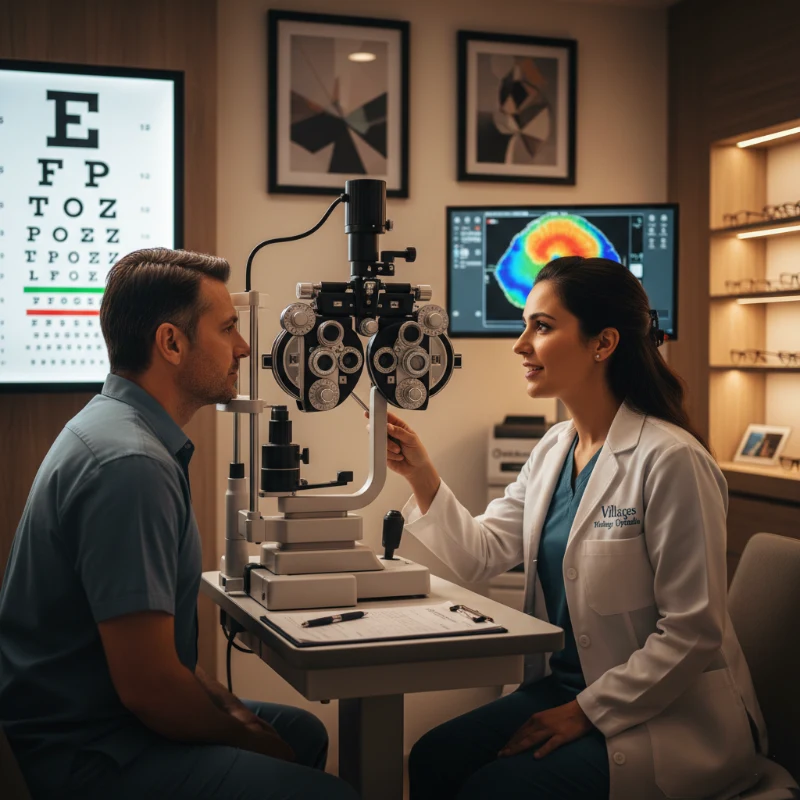
B. Objective Refraction: The Tech-Driven Starting Point (Detailed)
The objective refraction is the high-tech, initial phase where our advanced instruments provide an accurate, unbiased, and objective (independent of your answer) measure of your refractive error. This provides the foundational “guess” or starting point for the doctor, ensuring the subjective test is faster and more precise.
- The Autorefractor/Retinoscope:
- How it Works: You look into a sophisticated machine—the autorefractometer—which emits an invisible, non-harmful infrared light beam into your eye. It then measures the precise changes in the light beam as it is reflected back off the retina. By analyzing this returning wave of light, the device calculates the exact lens power needed to neutralize the error.
- Retinoscopy (The Classic Backup): For some patients, especially children or those who struggle to focus, the doctor may perform a retinoscopy. By shining a light and rotating a lens in front of the eye, the doctor watches the “reflex” of light moving across the pupil. The speed and direction of this movement tell the doctor exactly which lens power is needed. This is a classic skill refined over years of practice, and it demonstrates true clinical expertise.
- The Villages Opticals Advantage: Our investment in latest-generation digital autorefractors ensures this baseline measurement is incredibly precise, minimizing the variables and leading to a more accurate final result in the subjective test. This technological blueprint saves time and, more importantly, enhances the final prescription’s accuracy.
C. Subjective Refraction: The Critical Patient-Doctor Interaction (The Art of Vision)
This is the famous, crucial part of the Refraction Eye Exam—the part that turns a machine reading into a perfectly personalized prescription. This subjective phase requires the doctor’s expert judgment and your direct, honest feedback.
- The Phoropter: Which is Better? 1 or 2? (The Core Process)
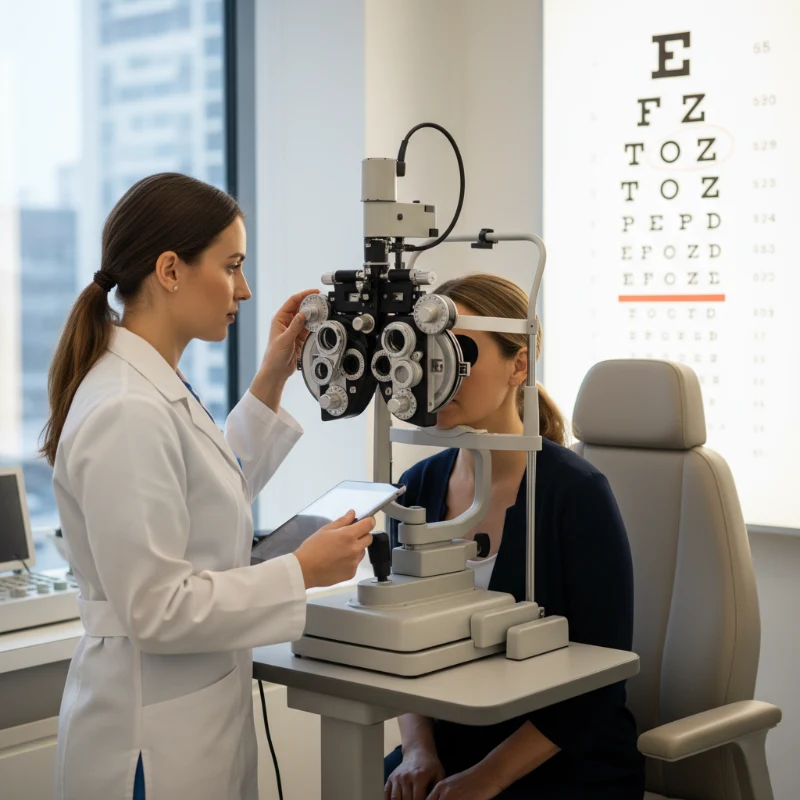
- The Procedure: Our specialist uses the phoropter (the large, complex instrument with rotating lenses) and asks you to focus on a standardized Snellen eye chart (letters) or an advanced, high-contrast digital chart. The chart is typically viewed at an optical infinity equivalent of $20$ feet or $6$ meters.
- The Refinement Process: This systematic process involves refining three key numerical components of your prescription:
- Sphere Refinement (The Power Check): The doctor uses the “Maximum Plus to Maximum Visual Acuity” technique, adding slightly more plus power to relax the eye’s focus, and then slowly reducing it until the patient achieves the smallest, clearest line of print.
- Cylinder and Axis Refinement (The Astigmatism Check): This is the most complex step, often utilizing the Jackson Cross-Cylinder (JCC) test. The JCC rapidly flips between two lenses (the “1 or 2” choices). This process precisely dials in the power of the Cylinder (CYL) needed for astigmatism correction and determines the exact Axis (orientation) of that correction.
- Your Feedback is Authority: Your simple, immediate response of “one” or “two” is the direct data point that confirms the finest visual adjustments. Your feedback is absolutely critical to the success of the final prescription; we partner with you to achieve perfection.
- Binocular Balancing and Duochrome Testing (Harmony and Focus):
- Binocular Balancing: This is a final, sophisticated step where we ensure your two eyes work together harmoniously. It guarantees that the effort used by your right eye to focus matches the effort used by your left eye. An imbalance can lead to fatigue and headache-inducing phorias (hidden eye alignment issues). This step is essential for reducing eye strain, improving depth perception, and ensuring maximum comfort for all-day wear of your new corrective lenses.
- The Duochrome Test: As a final precision check, the doctor may present a field split into red and green. Because of the physics of how light focuses, a patient with a perfectly focused eye will see the letters on the red and green sides equally black. If one side is clearer, a minor spherical adjustment is made. This test provides objective validation of the subjective result, confirming the $\pm 0.25$ D final precision.
Part II: Understanding and Correcting Refractive Errors (The Deeper Cause)
The meticulous Refraction Eye Exam is the only way to accurately diagnose and quantify the common refractive errors that blur your vision.
A. Myopia (Nearsightedness) Correction Dynamics
- The Cause and Effect: Myopia occurs when the eyeball is too long (Axial Myopia) or the cornea is too steeply curved (Curvature Myopia). This forces light to focus in front of the retina, resulting in blurry distance vision.
- Correction: The refraction eye exam determines the precise negative (minus) lens power needed. These lenses are concave, diverging light rays before they hit the eye’s natural lens, effectively pushing that focal point backward to land perfectly on the retina. The stronger the negative number (e.g., $-5.00$ D), the greater the degree of nearsightedness.
B. Hyperopia (Farsightedness) Correction Dynamics
- The Cause and Effect: Hyperopia occurs when the eyeball is too short, or the focusing power of the cornea/lens is too weak, causing light to focus behind the retina. While this often causes blurry near vision, the real danger is the constant, subconscious straining (accommodation) required to force focus, which leads to eye strain, headaches, and reading fatigue, especially in younger patients.
- Correction: The refraction eye exam determines the necessary positive (plus) lens power. These lenses are convex, converging light rays before they hit the eye, effectively pulling the focal point forward onto the retina. Even small amounts of uncorrected hyperopia can cause significant daily discomfort.
C. Astigmatism Correction and The Axis Factor
- The Cause and Effect: Astigmatism is not a disease, but a common refractive error caused by an uneven curvature of the cornea or lens, making it resemble a football instead of a perfect sphere. This results in light focusing at multiple points rather than one, causing blurred or distorted vision at all distances.
- Correction: This requires a Cylinder (CYL) lens power, which has power only along one meridian to precisely compensate for the corneal irregularity. The crucial factor is the Axis, a number from $1$ to $180$ degrees, which represents the orientation of the cylinder correction. A one-degree error in the Axis can significantly reduce visual comfort and clarity. This is why the precision of the subjective refraction eye exam with the JCC is non-negotiable at Villages Opticals.
D. Presbyopia (Age-Related Near Vision Loss) and The ADD Power
The Cause and Effect: Typically noticeable in the early to mid-$40$s, Presbyopia is the natural hardening and loss of flexibility of the eye’s crystalline lens. It loses the ability to “accommodate” (change shape) to focus on close objects, resulting in the need to hold reading material farther and farther away.
- Correction: The refraction eye exam determines the necessary ADD (Addition) power—the extra magnification required for reading, starting usually around $+0.75$ D and progressing over time. This power is the foundation for reading glasses, bifocals, or the advanced zone technology used in progressive lenses. Accurately determining the ADD power is crucial for restoring near functionality.
Part IV: Beyond the Test Your Prescription and Vision Correction
The Refraction Eye Exam at Villages Opticals is the first step. The result is a precise, detailed prescription that seamlessly translates into your clearest vision.
A. Deciphering Your Prescription (The Ultimate Clarity Breakdown)
Understanding the numbers and abbreviations on your prescription is the final step in appreciating the value of your refraction eye exam and being an informed patient.
- OD / OS / OU: OD (Oculus Dexter – Right Eye) and OS (Oculus Sinister – Left Eye). OU (Oculus Uterque – Both Eyes). These are the first and most fundamental distinctions.
- SPH (Sphere): The lens power for correcting nearsightedness or farsightedness, measured in Diopters (D). A minus sign $(-)$ indicates myopia (nearsightedness), while a plus sign $(+)$ indicates hyperopia (farsightedness). The higher the number (regardless of the sign), the stronger the prescription.
- CYL (Cylinder): The power needed to correct astigmatism, also measured in Diopters. This number represents the degree of irregularity in the eye’s shape.
- Axis: A number from $1$ to $180$ degrees. This defines the exact meridian (orientation) of the cylinder correction. This number is utterly useless without the CYL value and vice versa.
- ADD (Addition): The extra magnifying power required for reading/near work for patients with presbyopia. This value is always a positive number and is applied to the bottom portion of a multi-focal lens.
- Prism: Used in rare cases to help correct eye alignment issues (strabismus or double vision). This directs light to force the eyes to work together comfortably, preventing severe eye strain.
B. Why Accuracy Matters: The Villages Opticals Difference (Quantified)
The difference between a good refraction and a perfect refraction can feel like the difference between seeing and living. We quantify the risk of accepting anything less than our precision:
| Risk of Rushed Refraction | Impact of Precision Refraction |
| Chronic Eye Strain: Even a $0.25$ Diopter error forces eye muscles to constantly compensate, leading to daily fatigue and chronic headaches. | Effortless Focus: A prescription perfected to the quarter-diopter means the lens does all the work, allowing your eye muscles to rest, even during all-day screen use. |
| Reduced Performance: Difficulty with prolonged computer work, driving at night, reading fine print, and sports performance. | Maximum Potential: Achieve your true BCVA, maximizing visual performance for work, driving, and recreational activities. |
| Wasted Investment: A poor prescription renders expensive glasses or contact lenses useless, leading to frustration and the cost of re-testing. | Guaranteed Comfort: Your investment is protected by a prescription that is meticulously vetted for optimal, all-day visual comfort. |
At Villages Opticals, we guarantee a precision refraction that is meticulous, thorough, and designed for your long-term comfort and optimal performance. We don’t settle for “good enough” we demand perfect.
C. The Contact Lens Evaluation Refraction’s Critical Partner (The Geometry of Fit)
It is a pervasive and dangerous misconception that a glasses prescription from a refraction eye exam is all you need for contact lenses. This is FALSE.
- The Key Difference: The lens-to-eye distance. A glasses lens sits $\sim 12$mm in front of the cornea, whereas a contact lens rests directly on the eye. This physical difference changes the required optical power (called vertex distance conversion).
- What the Contact Lens Exam Measures: The contact lens fitting takes the $\text{SPH}$ power from the refraction and then measures the unique geometry of your eye:
- Base Curve (BC): The precise curvature of your cornea. A poorly fit Base Curve will result in discomfort, lack of movement, and possible eye damage.
- Diameter (DIA): The size of the lens needed to comfortably cover the cornea.
- Material & Modality: Choosing the right lens material (hydrogel, silicone hydrogel) and replacement schedule (daily, monthly) based on your tear film and lifestyle factors impossible to assess during a standard refraction.
Villages Opticals Commitment: We always couple the high-precision Refraction Eye Exam with a detailed contact lens fitting to ensure your lenses are a perfect optical and anatomical match, providing not just $20/20$ clarity, but critical all-day comfort and safety.
Part V: Refraction for Every Age & Stage of Life (Specialized Care)
Vision needs evolve dramatically over a lifetime. The Refraction Eye Exam is not one-size-fits-all; it adapts to the unique challenges of every patient demographic.
A. Pediatric Refraction: The Foundational Step for Learning
For children, an accurate refraction eye exam is absolutely crucial for proper visual and cognitive development. Undetected refractive errors—especially hyperopia (farsightedness) or significant astigmatism can lead to amblyopia (lazy eye) if not corrected early.
- Specialized Techniques: Our pediatric specialists use advanced techniques that don’t rely on verbal feedback. This includes Cycloplegic Refraction, where eye drops temporarily relax the eye’s internal focusing muscles, preventing the child from “accommodating” and forcing a clear view. This ensures we measure the true, total refractive error, not just what the child’s straining muscles can compensate for.
- Preserving Visual Learning: Since $80\%$ of a child’s learning is visual, a precise, annual refraction is a foundational step in preventing academic struggle and ensuring the development of lifelong binocular vision skills.
B. Refraction and Digital Life (The Intermediate & Digital Add)
The modern lifestyle is overwhelmingly focused on intermediate vision (computer screens) and near vision (smartphones). This places new, high-demand stresses on the focusing system that older refraction methods never accounted for.
- The Intermediate Focus Check: During the refraction, we specifically measure your focusing ability for a comfortable working distance of $\sim 24$ to $32$ inches (the distance to a typical computer monitor).
- The “Digital Add” Solution: Prolonged digital focus often leads to Digital Eye Strain. For pre-presbyopic patients (under $40$), we can prescribe specialized lenses that incorporate a minor “digital add” or enhanced reading power in the bottom portion of the lens. This small boost reduces the muscle effort required to sustain focus, preventing fatigue and dryness during 8+ hours of screen time. We believe your best prescription is the one that works best for your actual 21st-century lifestyle.
Part VI: Refraction and Systemic Health (The Comprehensive View)
A refraction does not diagnose disease, but it is an integral part of the overall comprehensive eye exam that is your first line of defense against vision loss.
A. Distinguishing Refraction from the Comprehensive Exam
It’s vital to know the difference between the refraction and the entire exam:
| Procedure Component | Purpose |
| Refraction Eye Exam | Measures refractive error ($\text{SPH}$, $\text{CYL}$, $\text{AXIS}$) to determine the power of corrective lenses. |
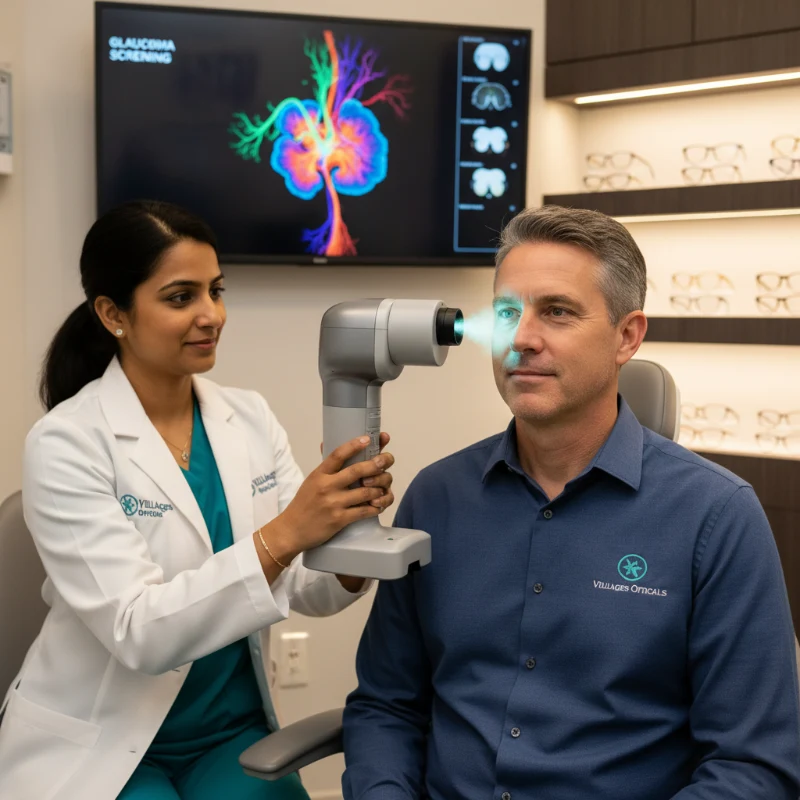
| Comprehensive Eye Exam | Measures eye pressure (glaucoma check), examines the retina and optic nerve (to detect diabetes, macular degeneration, and hypertension), and screens for cataracts and corneal issues. |
Villages Opticals always integrates the two. You get the precision of the refraction and the protection of a full health screening in one visit. We are not just giving you glasses; we are protecting your sight.
B. The Importance of Dilation (Why We Insist)
The refraction is often followed by pupil dilation. This is not for the refraction itself, but for the health check. Dilation is essential because:
- Unobstructed View: It allows the doctor an unobstructed, panoramic view of the internal structures of the eye, particularly the retina and optic nerve, which are otherwise hidden behind the iris.
- Early Disease Detection: This is how we detect silent, systemic diseases like diabetic retinopathy, glaucoma (optic nerve damage), and macular degeneration before they cause noticeable vision loss.
- Confirming Refraction in Specific Cases: In rare instances, dilation can be used to perform the cycloplegic refraction mentioned earlier, ensuring absolute accuracy for patients with strong focusing power that may hide their true prescription.
Part VII: Common Questions & Myth-Busting
To solidify our position as the ultimate authority and capture the valuable long-tail, conversational search queries, we address common patient concerns with expert confidence.
Q1: Why is the Refraction Test Not Always Covered by Insurance? (The Economic Reality)
The Critical Answer: This is one of the most common points of confusion. It is true that some medical insurance plans cover the comprehensive eye exam (checking for medical diseases like glaucoma, cataracts, and diabetes), but they may not cover the refraction eye exam (determining the lens power). The refraction is technically considered the measure to determine a refractive error, which is corrected by non-medical means (glasses/contacts), and is billed separately. Villages Opticals is absolutely transparent about this. We charge a fair, competitive fee for this service because it is the most crucial step in getting you a functional prescription. You are paying for $\pm 0.25$ Diopter precision, not just a number. You are investing in clarity.
Q2: Does the “1 or 2” Question Rely Only on My Answers? What if I Guess Wrong?
The Authority Answer: The subjective refraction is a partnership. While your answers are the most critical part, the process is designed to be fail-safe and prevent “guessing wrong.” The doctor always starts with the highly accurate objective data from the autorefractor and uses your current prescription. The “1 or 2” choices only present tiny, incremental changes. If you consistently guess incorrectly, the image will actually get blurry, and your Villages Opticals specialist will immediately recognize this trend and revert to the clearest baseline. It’s a guided, systematic process where the optometrist’s expertise interprets your response for maximum accuracy.
Q3: How often do I need a Refraction Eye Exam?
The Expert Recommendation: For virtually every adult and child, we highly recommend a comprehensive eye exam, including a refraction, at least once every year. Vision changes are often gradual and subtle. What seems like a minor blur can escalate into significant eye strain, headaches, and a compromised quality of life. An annual refraction ensures your prescription is always optimized to its highest level of performance and is a critical preventative step for monitoring eye health conditions like glaucoma. Don’t wait for your vision to deteriorate before you act—stay ahead of the curve.
Q4: Can I Skip the Refraction if I Already Have Glasses?
The Direct Answer: NO. Your prescription expires. Just because you have an old pair of glasses doesn’t mean the prescription is still correct. Lenses change, and the eye changes. Even small changes of $0.50$ Diopters can cause significant fatigue. An annual refraction eye exam is the only way to confirm if your current lenses are still providing your Best Corrected Visual Acuity or if they are holding your vision back.
Conclusion: Secure Your Sharpest Vision at Villages Opticals
When you choose Villages Opticals for your Refraction Eye Exam, you’re not choosing a routine service; you’re choosing precision, expertise, and your best possible vision. We are your #1 local choice for this critical procedure.
The clarity of your world depends on the accuracy of your prescription. Don’t trust your eyesight your most valuable sense to a rushed, low-quality refraction performed by unspecialized providers. Our commitment to utilizing the most advanced digital technology and our rigorous, multi-step subjective testing protocols ensure that the prescription you receive is the most accurate, comfortable, and performance-enhancing you can get.
Your wait for crystal-clear, high-definition vision ends now.
Action Plan: Book Your Precision Refraction Today
Visit Our Store: 3479 Wedgewood Ln, The Villages, FL 32162, United States
Don’t settle for “good enough” vision. Demand the precision you deserve.